
More Cruisers Are Looking for Alternatives to AI Search
Google wants you to trust AI instead of the people who actually took the cruise.
That may sound dramatic, but it’s increasingly becoming the reality of online search.
Instead of directing users to websites that researched an answer, sailed a ship, visited a destination, or tested a product, Google is increasingly placing AI-generated summaries at the top of search results. In many cases, users can get an answer without ever visiting the websites that originally created the information.
The problem is that AI gets things wrong.
When AI Sounds Confident, It Can Still Be Wrong
One of the biggest challenges with AI-generated search results is that incorrect information is often presented with the same confidence as accurate information.
Unlike a discussion forum where multiple people can weigh in or an article that links to sources, AI-generated answers frequently provide a single response that appears authoritative. Most users have no way of knowing whether that answer is accurate, outdated, incomplete, or entirely incorrect.
We’ve already seen examples of AI-generated answers providing incorrect cruise policies, outdated ship information, and misleading descriptions of onboard features.
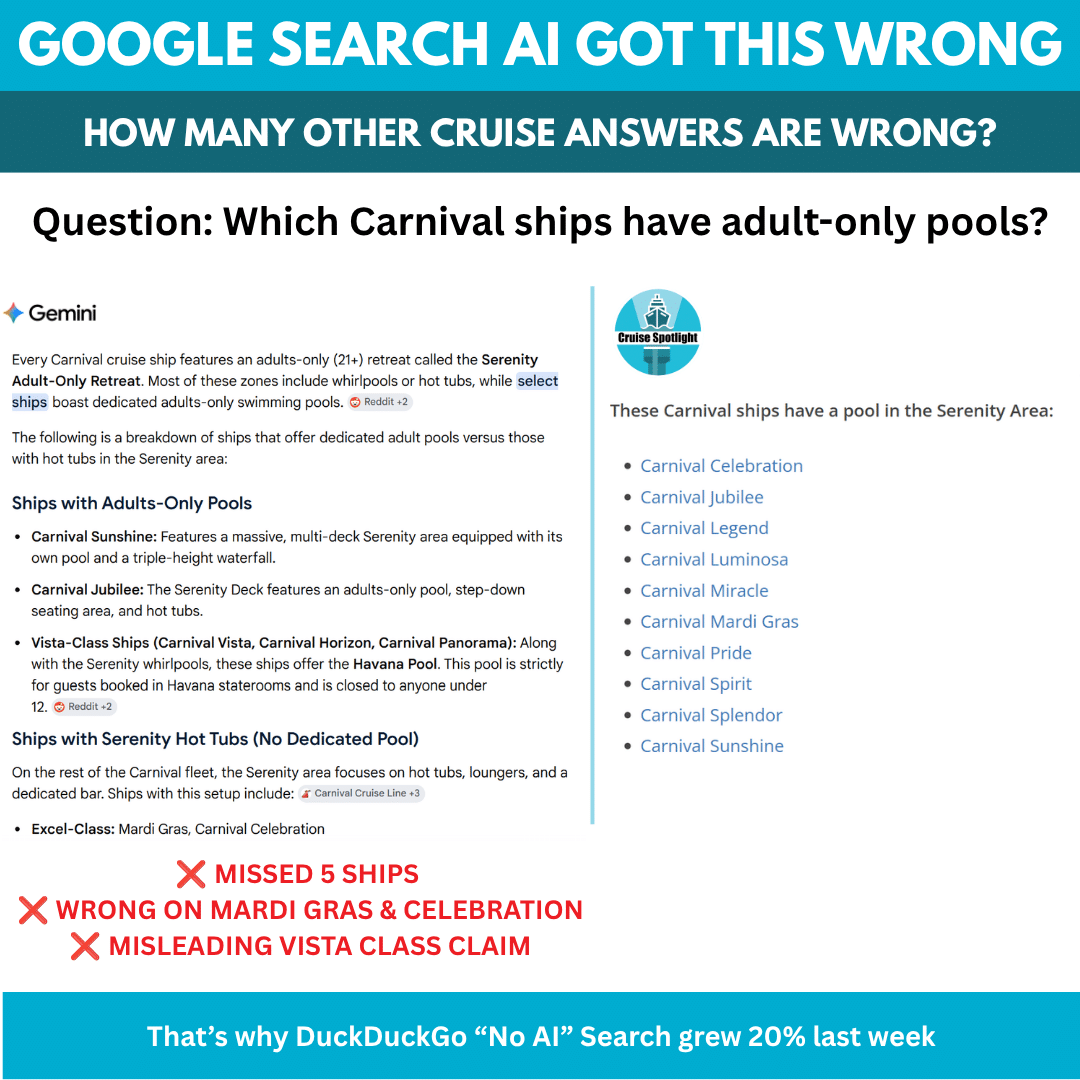
Recently, we compared a Google AI answer about which Carnival cruise ships have adults-only pools to CruiseSpotlight’s database. The AI answer contained multiple errors and omissions, including missing ships and misleading information about others.
That wasn’t the only problem. We asked which ships have covered pools? Which ships a certain bars were on? Questions about destinations. All had factual inaccuracies. The big concern is that AI often presents those mistakes as facts.
Why This Matters for Cruisers
Cruise vacations are expensive. Choosing the wrong cabin, misunderstanding a ship feature, missing an important policy, or booking based on inaccurate information can easily cost hundreds or even thousands of dollars. That’s why firsthand experience matters.
At CruiseSpotlight, we’ve spent years sailing cruise ships, visiting ports, testing excursions, comparing cabins, photographing venues, and gathering information directly from cruise lines and onboard experiences.
AI didn’t take those cruises. AI didn’t stand in the buffet line. AI didn’t compare the cabins. AI didn’t experience the ship.
It simply reads information created by others and attempts to summarize it. Sometimes it does a good job. Sometimes it doesn’t. The problem is that users often can’t tell the difference.
Google Is Doubling Down on AI
Google has made it clear that AI will play an even larger role in search going forward. Rather than being a small feature, AI-generated answers are increasingly becoming the centerpiece of the search experience.
For website publishers, this means fewer visitors are reaching the original source. For users, it means fewer opportunities to verify information, read context, and compare multiple viewpoints.
The internet has traditionally worked because users could discover original sources and decide for themselves which information they trust. AI changes that dynamic by inserting itself between users and the creators who produced the information.
Why Some Users Are Switching
As Google’s AI search efforts expand, some users are actively seeking alternatives.
One of the most notable examples is DuckDuckGo’s “No AI” search option, which removes AI-generated answers and focuses on traditional search results. The company recently reported a significant increase in both app installs and visits to its AI-free search page following Google’s latest AI announcements.
The appeal is simple. Some users don’t want an AI summary. They want the original source. They want to read the article, visit the website, and decide for themselves whether the information is trustworthy.
The Value of Original Sources
AI can be a useful tool. But when it comes to planning vacations, spending money, and making important decisions, original sources still matter.
The people who actually took the cruise, visited the destination, tested the excursion, or reviewed the cabin often provide details and context that an AI summary simply cannot replicate.
The internet works best when creators are rewarded for creating and readers can easily find the information those creators worked hard to produce.
Whether you continue using Google, switch to DuckDuckGo, or try another search engine entirely, one thing is worth remembering: Always verify important information. Especially when an AI is providing the answer.
CruiseSpotlight is an Amazon Associate. We may earn a commission when you click links to retailers and purchase goods.
